 O'zbek
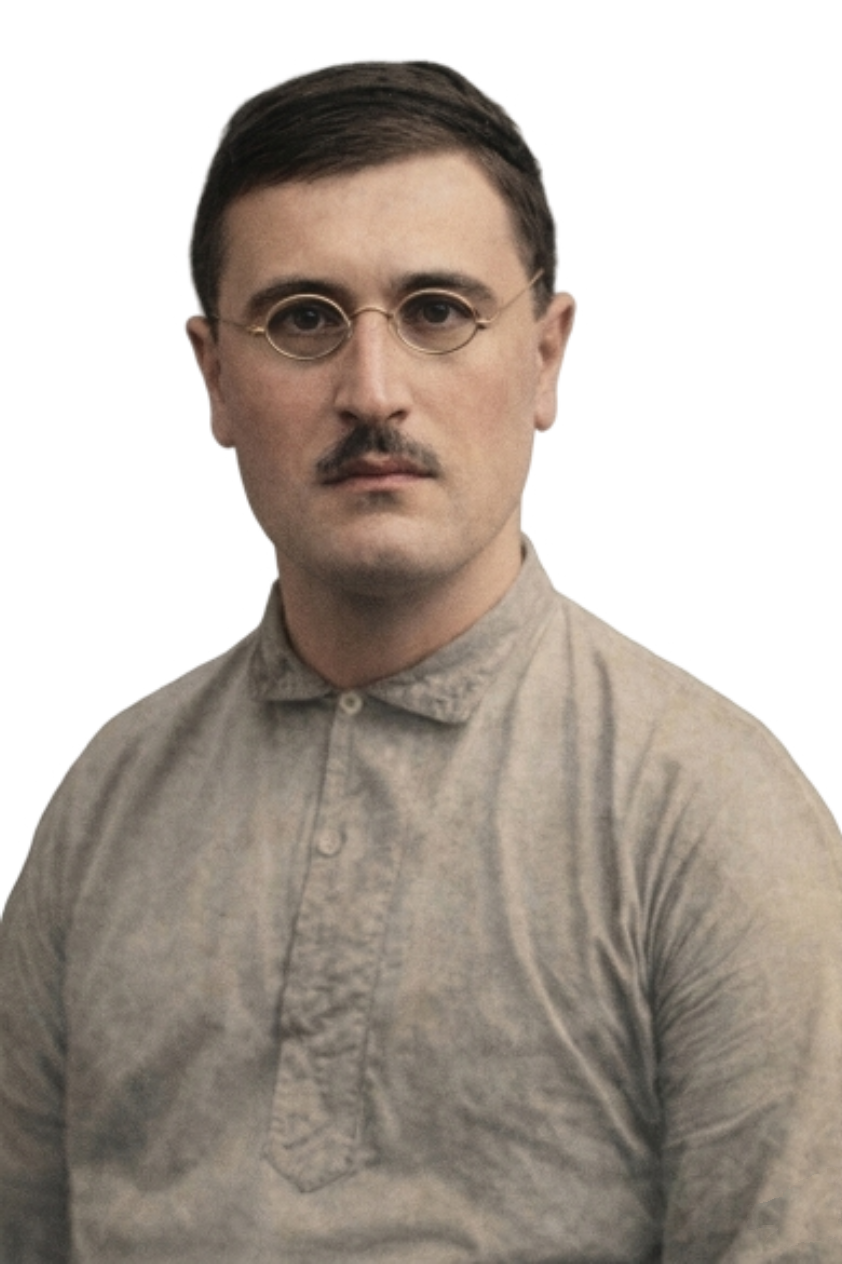
ABDULHAMID SULAYMON O‘G‘LI — CHO‘LPON
(1897–1938) Abdulhamid Sulaymon o‘g‘li Cho‘lpon was born in 1897 [Documents give the dates 1896, 1897 and 1898. However, since Cho‘lpon himself recorded “1897” in documents from 1925 until his death, as well as in his personal passport and questionnaires, this date is regarded as reliable and has been accepted by the scholarly community.] in the Qatorterak neighbourhood (now Navoi Avenue) of the city of Andijan, into the family of Sulaymonqul Muhammadyunus o‘g‘li (1874–1929), a cloth merchant (bazzoz). Cho‘lpon’s ancestors are known to have come from the village of Yorqishloq in the Khojaobod district of the Andijan region, where they were farmers. His grandfather, Muhammadyunus Okhund, moved to Andijan in the early 1870s, bought a house and plot at the above address and settled there. According to recently established information, Muhammadyunus Okhund was a learned man who for many years taught as a mudarris at the Kholbek Qushbegi Madrasa, one of the most prestigious educational institutions in the city; he died in 1905. Thanks to the healthy spiritual atmosphere in the family, all of Muhammadyunus Okhund’s children grew up to be enlightened people of their time. Sulaymonqul in particular studied at a madrasa for many years and excelled in the religious sciences, so the townspeople respectfully addressed him as “Mullah Sulaymonqul Okhund”.
In addition, a number of sources held in the collection of the Andijan Regional State Museum of History and Culture — in particular more than 100 rare books from his personal library and a 300-page manuscript divan collecting his literary legacy — testify that he was a man of mature scholarly ability and creative talent. Cho‘lpon received his first schooling at an old-method school. As the eldest of four children and the only son in the family, Abdulhamid was given serious attention in his education and upbringing from a very early age. Once he had learned to read and write, his father hired private tutors, striving to give him a more thorough education and to meet all his material needs. When Cho‘lpon began his studies, a number of religious madrasas were operating in Andijan. Although he later recalled studying at a madrasa, there is no precise information about exactly when and at which madrasa he studied. As the times required, he first received a solid religious education and learned Arabic and Persian, and he also studied the necessary secular subjects — especially arithmetic — with Turkish and Tatar teachers. Recent research suggests that he may have learned Russian privately at home or at the Russian-native school in the city of Osh. This can be inferred from his later ironic remarks about, and negative attitude towards, the Andijan Russian-native school. Having contributed to the newspapers “Sadoyi Turkiston” and “Sadoyi Farg‘ona” in 1914–1915, Cho‘lpon worked in 1915–1917 on the editorial staff of “Turkestanskiy Golos” (“The Voice of Turkestan”), a newspaper published in Andijan. In mid-1917 he ran a reading room opened in the Old Town of Andijan. In 1918–1919 he worked as a teacher.
In 1919 he worked in the education department of the Andijan uyezd (district) and at the Fergana regional courses for Turkic teachers. In 1919–1921 he headed the Tashkent Old Town branch of ROSTA (the Russian Telegraph Agency). In the summer of 1920 he was head of the ROSTA Old Town branch in Andijan and executive editor of its newspaper, while also teaching on a six-month preparatory course. In 1920 he served as director of the “Turon” theatre. In 1921–1922 he was editor of the newspaper “Buxoro axbori” (“Bukhara News”) and for a time headed the State Publishing House of the Bukharan Republic. In 1921–1922 he served as chairman of the Uzbek Scholarly Commission. From May 1923 he worked in Andijan for the newspaper “Darxon”. After “Darxon” closed, he worked at the Andijan uyezd military-revolutionary committee and in its Waqf department. In October 1923 he married a young woman named Soliha. In December of the same year he moved to Kokand, where he worked as a literary staff member and correspondent for the newspaper “Farg‘ona”. In 1924–1925 he was a correspondent for the newspapers “Farg‘ona” and “Turkiston”. In 1925–1927 Cho‘lpon worked in Moscow as a translator and literary staff member of the Uzbek drama studio at the Bukhara House of Education. In 1927–1931 he was a literary collaborator with the Uzbek State Theatre Troupe in Samarkand. In 1927–1928 he worked for the newspaper “Zarafshon”. In 1931–1934 he worked in Moscow as a translator for the Council of People’s Commissars of the USSR. In mid-1934 he returned to Tashkent and worked as a literary collaborator at the Hamza Theatre and as a literary staff member of the magazines “Mushtum” and “Guliston”.
- He was arrested on 13 July 1937 and shot as an “enemy of the people” on 4 October 1938.
- He was rehabilitated in 1958.
- He was awarded the Alisher Navoi State Prize in 1991 and the Order of “Mustaqillik” (Independence) in 1999.